From Brain to Equifax: 4 Cybersecurity Attacks That Changed Computing
A comparison-style look at four landmark cyberattacks, from Brain in 1986 to the Equifax breach in 2017, and what each one changed for developers and defenders.
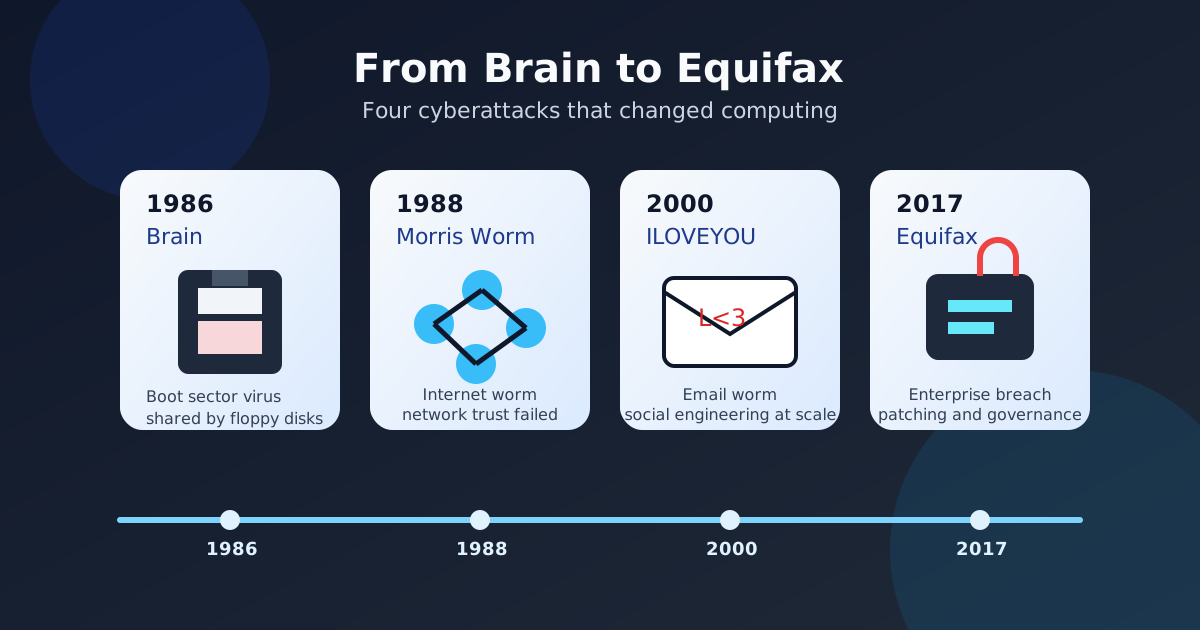
Cybersecurity history is easy to flatten into a blur of “old virus, old worm, old breach.” But these incidents did not all fail in the same way, and they did not teach the industry the same lesson.
Taken together, Brain, the Morris worm, ILOVEYOU, and the Equifax breach show a very clear progression:
- the floppy-disk era, where malware spread through trusted physical exchange
- the early internet era, where insecure network services could turn one program into a national event
- the email era, where social engineering scaled faster than purely technical exploitation
- the modern enterprise era, where weak patching, poor visibility, and bad governance could expose millions of people at once
The details matter because the attack surfaces changed, but the pattern stayed familiar: trust something too easily, fail to contain it, and discover too late how interconnected the system really is.
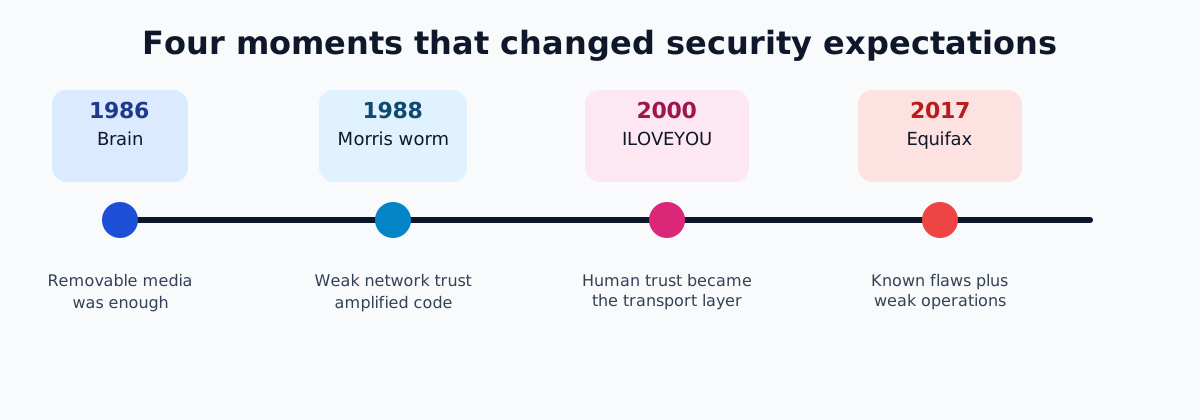
Fast Comparison
| Incident | Exact year/date | Attack type | Primary target | Spread or entry path | Immediate impact | Lasting lesson |
|---|---|---|---|---|---|---|
| Brain | January 19, 1986, commonly cited | Boot-sector virus | IBM PC compatibles using floppy disks | Infected boot sectors on shared floppy disks | Slowdowns, disk confusion, and one of the first global IBM PC virus scares | Physical media can be a security boundary only until people start sharing it casually |
| Morris worm | November 2, 1988 | Internet worm | Networked Unix systems | sendmail, fingerd, trusted hosts, and password guessing | Roughly 6,000 of about 60,000 internet-connected machines disrupted within a day | Autonomous code plus weak defaults can create denial-of-service conditions without a destructive payload |
| ILOVEYOU | May 4, 2000 | Mass-mailing worm with social engineering | Windows users and corporate mail systems | Email attachment sent to all Outlook contacts | Mail systems worldwide overloaded; many organizations shut down email gateways | Users are part of the attack surface, and a believable lure can outrun perimeter defenses |
| Equifax | Attack began May 13, 2017; discovered July 29, 2017; publicly disclosed September 7, 2017 | Data breach | Equifax consumer data systems | Unpatched Apache Struts flaw, web shells, credential reuse, poor segmentation | Personal data on roughly 143 million people disclosed initially, later revised upward | Patch management and visibility failures can turn a known vulnerability into a national-scale breach |
Brain
What happened
The Brain virus is widely treated as the first major virus epidemic for IBM PC compatibles. Historical summaries usually date its first release to January 19, 1986, and attribute it to brothers Basit and Amjad Farooq Alvi in Lahore, Pakistan.
Unlike many later malware families, Brain did not win attention by destroying everything in sight. It became important because it proved that a virus targeting ordinary personal computers could spread well beyond one shop, one city, or one lab.
How the attack worked
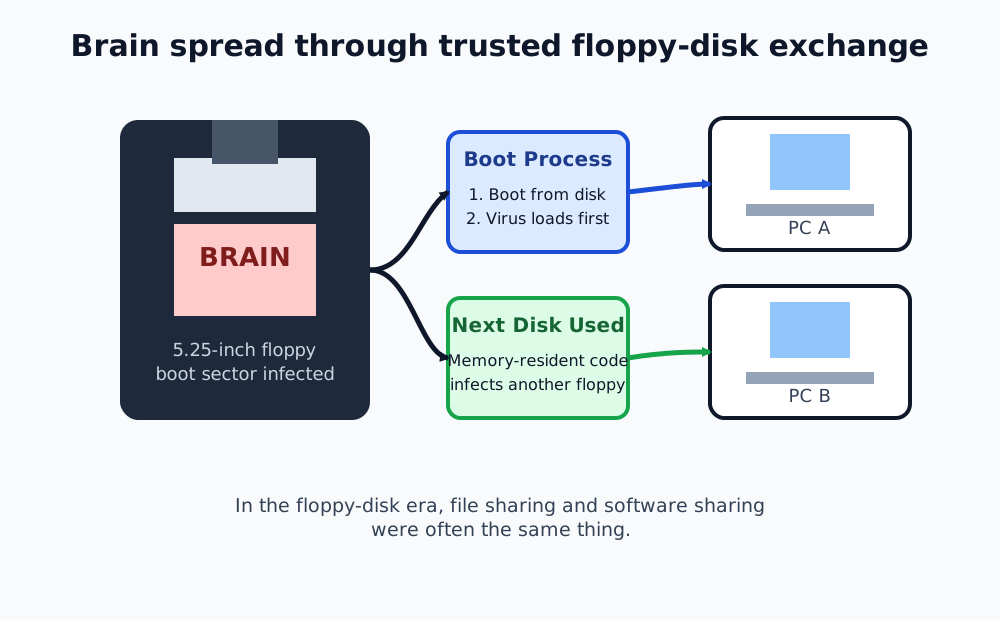
Brain was a boot-sector virus. When a machine booted from an infected floppy, the virus loaded before the operating system and copied itself into memory. From there, other floppy disks accessed on that machine could also be infected.
That mattered in 1986 because floppy disks were not just storage. They were also software distribution, file transfer, and casual collaboration. In practice, passing disks around was part of normal computing.
Brain also used an early stealth trick: it moved the original boot sector and tried to make the infection less obvious during casual inspection.
Why it spread or succeeded
Brain spread because the environment trusted the medium. If a disk came from a colleague, a classmate, or a vendor, it usually felt trustworthy.
There were also very few mature user habits or tools for malware defense on PCs at the time. Modern instincts like scanning downloads, restricting autorun behavior, or expecting signature updates simply were not standard yet.
Immediate impact
Brain was not famous for a spectacular destructive payload. Its impact was more foundational than cinematic:
- it demonstrated that the IBM PC ecosystem was now large enough for malware to travel widely
- it created operational confusion around infected disks and unreliable boots
- it helped push antivirus from a niche concern toward a real software category
What changed afterward
Brain pushed the industry toward thinking about malware as a personal computing problem, not just a laboratory curiosity. It also highlighted how removable media could act as a supply chain and trust problem long before anyone used that language.
Lesson for today
If users routinely exchange something, attackers will eventually use that same channel for distribution.
Morris Worm
What happened
On November 2, 1988, at about 8:30 p.m., the Morris worm was released onto the early internet from a machine at MIT. Within 24 hours, the FBI later summarized, an estimated 6,000 of roughly 60,000 internet-connected computers had been affected.
This was the moment when a connected network stopped feeling like a research convenience and started looking like a shared risk surface.
How the attack worked
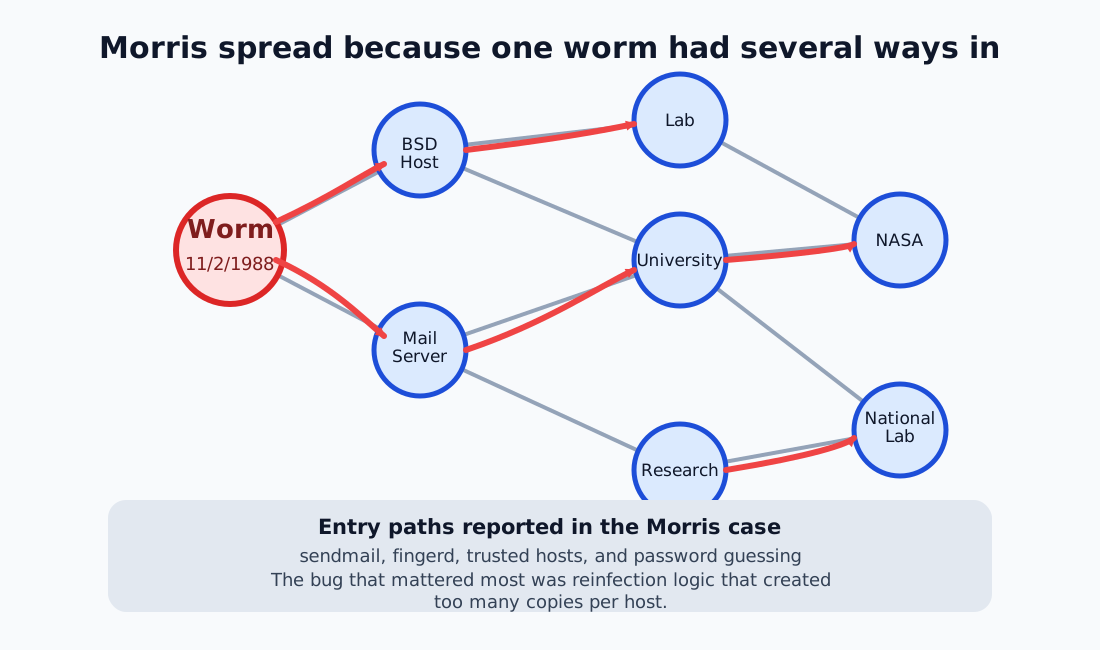
The Morris worm spread through multiple paths instead of relying on just one bug:
- a flaw in
sendmail - a buffer-overflow bug in
fingerd - trusted-host relationships
- password guessing against weak credentials
That combination made it resilient. Even if one path failed, another might work.
The most important design mistake, however, was not the entry vector. It was the worm’s reinfection behavior. To avoid being blocked by systems that lied and claimed they were already infected, the worm sometimes copied itself anyway. In practice, that caused far too many duplicate copies to pile up on the same hosts.
Why it spread or succeeded
The early internet was smaller than today’s internet but far more trusting in some crucial ways. Research and university systems often assumed a friendlier environment, and security boundaries were weaker than the value of the network now demanded.
Morris also benefited from composability: one worm, several techniques, one network, many targets with similar software and assumptions.
Immediate impact
The Morris worm did not need to wipe disks to cause damage. Systems slowed, crashed, or became unusable because they were overwhelmed by copies of the worm. Some sites disconnected from the network entirely while teams figured out how to stop reinfection.
Operationally, this is one reason the incident still matters. It showed that software can become destructive through resource exhaustion, even when its original author does not intend classic sabotage.
What changed afterward
The worm is closely tied to the creation of CERT/CC and to a more formal model of coordinated incident response. It also became the basis for the first major felony conviction under the U.S. Computer Fraud and Abuse Act.
Just as importantly, it changed the culture. Networked systems could no longer be treated as a largely academic commons that would regulate itself.
Lesson for today
Automation turns small security mistakes into system-wide incidents faster than humans can react.
ILOVEYOU
What happened
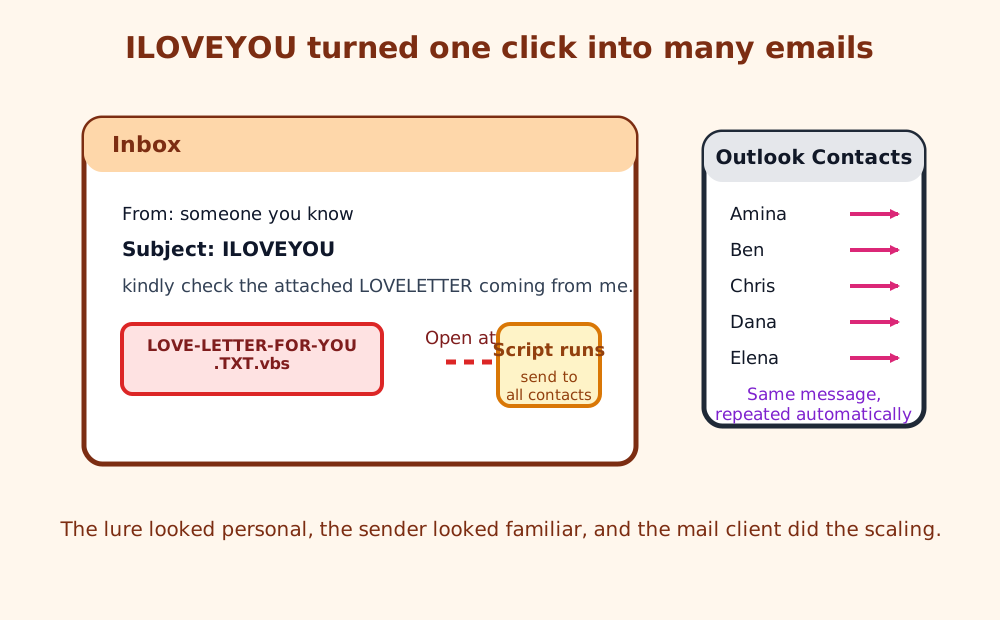
The ILOVEYOU worm, also known as the Love Letter attack, began spreading on May 4, 2000. It arrived with a subject line that looked personal and an attachment named LOVE-LETTER-FOR-YOU.TXT.vbs.
That combination was brilliant in the worst possible way. The lure was emotional, the filename hid the real extension from many users, and the distribution engine was already sitting on the victim’s desktop: Microsoft Outlook.
How the attack worked
Microsoft’s malware writeup still captures the core behavior succinctly: the worm arrived as an email attachment and sent itself to all Outlook contacts using the victim’s account.
Once opened, ILOVEYOU was not just a forwarding trick. It also copied itself locally, modified settings, and in many analyses was described as overwriting or replacing certain files while attempting to pull down password-stealing components.
In other words, it mixed three things that remain effective today:
- a compelling social-engineering lure
- automation through trusted client software
- additional post-infection behavior beyond simple propagation
Why it spread or succeeded
ILOVEYOU succeeded because the technical exploit and the human exploit were aligned.
People were already trained to trust email from people they knew. The worm used that trust directly by mailing itself from real contacts. Many users also did not clearly see the difference between a .txt file and a .vbs script when Windows hid known file extensions.
This is a pattern worth noticing: once a system makes dangerous actions look ordinary, attackers do not need advanced intrusion techniques. They need a believable pretext.
Immediate impact
ILOVEYOU spread fast enough that many companies and government organizations temporarily shut down or filtered email infrastructure just to slow the blast radius. That response alone says a lot about how disruptive it was: even before precise damage estimates settled, operators understood that normal email traffic could not be trusted.
What changed afterward
The worm accelerated several defensive habits:
- stricter filtering of dangerous attachments
- stronger suspicion toward scripts arriving by email
- better user education around filename extensions and deceptive messages
- recognition that endpoint security and email security had to work together
Lesson for today
If an attack rides on top of normal user workflow, “just be careful” is not a serious defense strategy.
Equifax
What happened
The Equifax breach was not an old-school virus story. It was a modern enterprise failure chain.
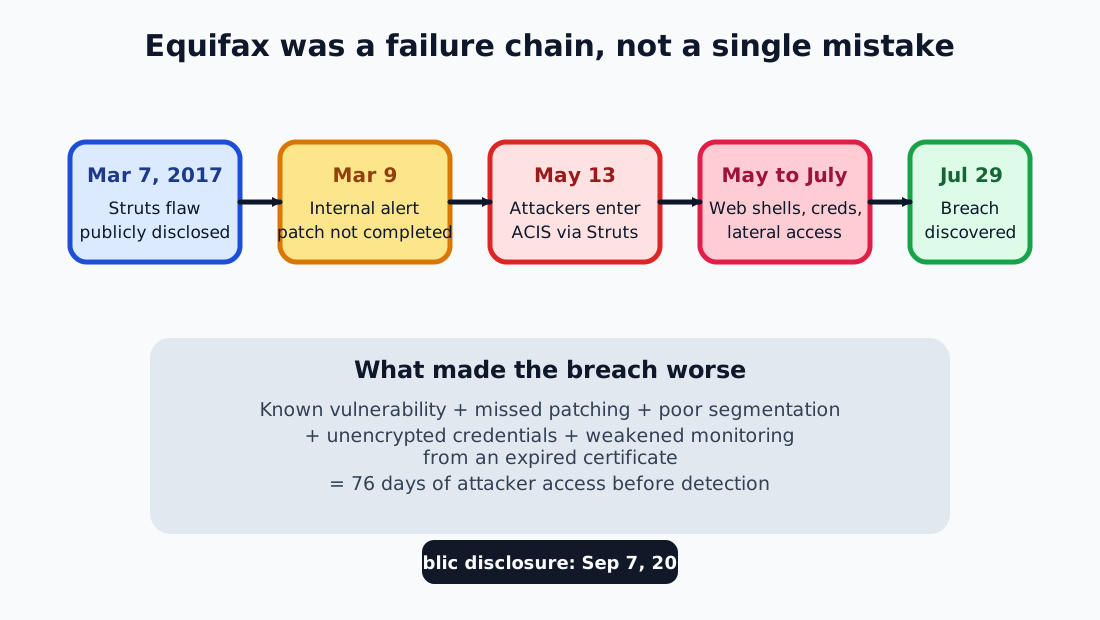
According to the U.S. House staff report, a critical Apache Struts vulnerability was publicly disclosed on March 7, 2017. Equifax was alerted immediately afterward and instructed internally to patch affected systems. But one critical internet-facing application, ACIS, remained exposed.
Attackers began exploiting that weakness on May 13, 2017. Equifax discovered suspicious activity on July 29, 2017. The company publicly disclosed the incident on September 7, 2017.
How the attack worked
The Equifax case is valuable because the public reporting is detailed enough to show a chain rather than a headline.
The House report says attackers used the unpatched Struts flaw to gain entry, dropped web shells for persistence, found unencrypted credentials, and then moved beyond the initial environment into additional databases. The same report says Equifax’s monitoring was weakened because a certificate on a traffic-inspection device had expired, leaving important visibility missing for 19 months.
This is not a story about one missed patch by one engineer. It is a story about detection, asset inventory, certificate management, segmentation, and governance all failing in sequence.
Why it spread or succeeded
Equifax did not face a mysterious zero-day. It faced a known vulnerability and failed to close the window.
That matters because it shifts the lesson from “attackers were too advanced” to “the organization did not execute basic security controls reliably enough.” The eventual scale came from what the attackers reached after entry, not just how they entered.
Immediate impact
At public disclosure, Equifax said the breach potentially affected about 143 million U.S. consumers. Later updates revised the total upward. The information exposed included names, Social Security numbers, birth dates, addresses, and in some cases driver’s license numbers, plus smaller sets of payment-card and dispute-document data.
Unlike a worm, this incident did not announce itself by crashing systems in public. Its damage was quieter and more durable. Personal data cannot be rotated as easily as a password, which is one reason the breach remains consequential years later.
What changed afterward
Equifax paid heavily in legal, regulatory, and reputational terms. The breach became a reference case for:
- patch management discipline
- security accountability at the executive level
- data minimization and segmentation
- the mismatch between the amount of personal data companies hold and the quality of the controls protecting it
It also sharpened a hard truth: some organizations hold data that individuals never meaningfully chose to entrust to them, which raises the bar for operational security even higher.
Lesson for today
In modern enterprises, catastrophic breaches often happen when ordinary controls fail quietly for too long.
What This Sequence Shows
These four incidents map neatly onto four eras of computing:
- Brain showed that malware could ride on whatever medium people already used to share work.
- Morris showed that a connected network with weak trust assumptions can amplify one program into a national outage.
- ILOVEYOU showed that users and applications can become the propagation mechanism when the lure feels familiar.
- Equifax showed that modern security failures are often organizational as much as technical.
The underlying pattern is not that attackers suddenly became clever in 2017. It is that computing became more connected, more layered, and more dependent on invisible operational discipline. Every era inherited the old risks and added a new one.
That is why these incidents still belong in the same conversation. They are not just famous attacks. They are milestones in how trust breaks.
Sources and Further Reading
- Brain: History of Information on Brain
- Brain: Kaspersky timeline entry for 1986
- Morris worm: FBI case summary
- Morris worm: Harvard case-study excerpt from United States v. Morris
- ILOVEYOU: Microsoft threat encyclopedia entry for Worm:VBS/LoveLetter.B
- ILOVEYOU: Microsoft threat encyclopedia entry for Virus:VBS/LoveLetter
- Equifax: Equifax September 7, 2017 disclosure
- Equifax: U.S. House staff report on the Equifax breach (PDF)
